Dr. G V Ramanjaneyulu, affectionately known as Dr. Ramoo, gave up a lucrative career in the Indian Revenue Service (IRS) to establish the Centre for Sustainable Agriculture (CSA). Through his innovative Non-Pesticidal Management (NPM) model, he has successfully guided over 7,000 villages across 30 lakh acres away from toxic chemical pesticides, drastically lowering farming costs and completely eliminating farmer suicides in partner communities.

Choosing the Soil Over the Civil Services
In 1995, Dr. G V Ramanjaneyulu successfully cleared the Union Public Service Commission (UPSC) examination and was offered a position in the Indian Revenue Service. Despite the prestige associated with the IRS, he turned it down to work as an agricultural research scientist at the Indian Council for Agricultural Research (ICAR).
However, observing the alarming rise in farmer suicides across Andhra Pradesh due to spiraling pesticide debts and toxic chemical exposure, he realized government research laboratories were disconnected from ground realities. In 2003, he resigned from ICAR and founded the Centre for Sustainable Agriculture in 2004.
The Power of Non-Pesticidal Management
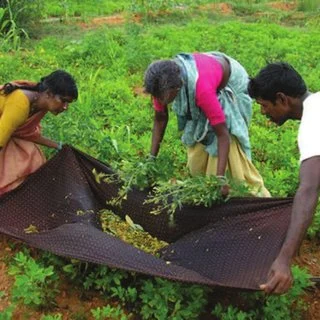
To address the agrarian crisis, CSA introduced Non-Pesticidal Management (NPM), an eco-friendly farming methodology that completely excludes synthetic chemical pesticides. Instead, farmers use botanical concoctions made from neem, garlic, chili, herb extracts, cow dung, and cow urine, combined with natural biological traps.
This transition reduces production costs by nearly 5,000 rupees per acre while improving soil fertility through crop rotation, composting, and green manure. From 2005 to 2008, CSA partnered with the Society for Elimination of Rural Poverty (SERP) to train women self-help groups, bringing over 30 lakh acres under non-chemical cultivation.

Transforming Villages and Connecting to Markets
The impact of Dr. Ramoo’s intervention transformed entire distressed regions. In Dorli, Maharashtra, a village once put up for sale due to crippling agricultural debts, farmers successfully restored economic viability through NPM. Similarly, Enabavi in Telangana transitioned into a completely organic village, achieving water surplus and high crop yields.
To ensure farmers received fair market prices without middleman exploitation, CSA launched Sahaja Aharam, a farmer-owned cooperative network now representing 22 cooperatives and 5,000 producers, selling over 250 organic certified products directly to consumers.

Scaling Impact and Value Addition
To further secure farmer livelihoods, Dr. Ramoo and his team expanded their operations beyond local production into food processing. By establishing localized processing facilities, CSA provides farmers with alternative revenue streams and prevents distress sales during market gluts. Today, their sustainable framework spans eight states, including Punjab, Maharashtra, Odisha, and Sikkim.
Through direct market integration, value-added products, and continuous technical mentorship, CSA empowers smallholders to transition from vulnerable debt-ridden cultivators into self-reliant, resilient agri-entrepreneurs capable of thriving in changing climate conditions.

Kisan Mitra and a Zero-Suicide Legacy
To address administrative delays and systemic challenges, CSA established Kisan Mitra, a dedicated toll-free helpline assisting farmers with crop insurance, land records, loans, and government subsidies. In a single district of Telangana, the helpline resolved over 3,000 farmer grievances. Most remarkably, across 14 years of intensive field operations in eight states, not a single farmer has committed suicide in villages adopting CSA’s sustainable model, demonstrating the immense power of community-centric ecological agriculture.

The Logical Indian’s Perspective
Dr. G V Ramanjaneyulu’s life work offers a compelling blueprint for solving India’s agrarian distress. By replacing toxic, capital-intensive chemical farming with low-cost, nature-based methods and establishing direct market links through cooperatives, CSA has restored financial dignity and health to thousands of rural families. His success proves that sustainable farming is not merely an environmental preference, but an essential economic strategy for protecting farmers’ lives.
How can government agricultural policies accelerate the adoption of Non-Pesticidal Management to eliminate debt and protect smallholder farmers across India?
Also Read: How One Man Transformed Bharipada, Maharashtra, Through Community-Led Conservation