




It feels like a harmless habit. A few minutes on short videos. A quick scroll before bed. A break between tasks. But what if this everyday behaviour is quietly adding up to an economic cost?
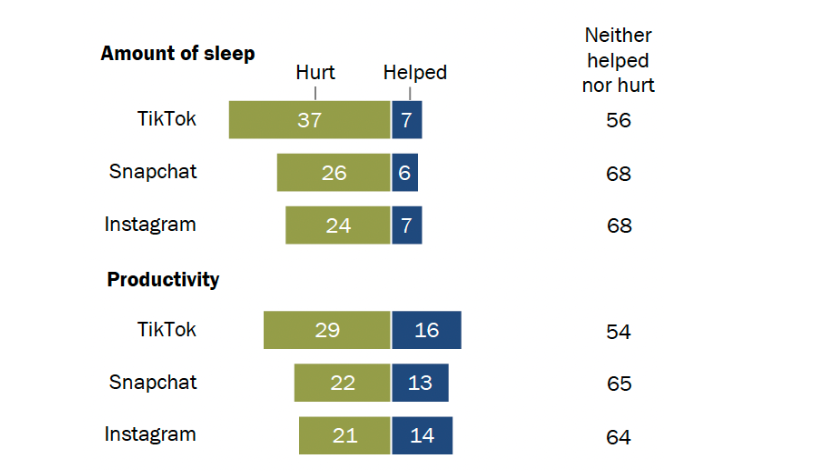
A recent report by Pew Research Center found that teens using platforms like TikTok are the most likely to say the app hurts their sleep and productivity, with around 40% reporting negative impact on sleep. This is not just a health concern. It is a signal of something larger.
When platforms are designed to maximise time spent, the cost is not limited to attention. It begins to affect output, focus, and long-term productivity.

Teens Use TikTok for Entertainment
For years, the tech industry has measured success through “engagement,” a polite term for how long a user stays glued to an app. According to report by pew research, this engagement has reached a fever pitch, particularly on TikTok.
While roughly nine-in-ten teens use TikTok, Instagram, or Snapchat for entertainment, TikTok stands alone as the undisputed heavyweight of the attention economy. An incredible 80% of its teen users cite entertainment as a “major reason” for their presence on the app.
Features like infinite scroll, autoplay, and algorithm-driven feeds are not accidental. They are built to reduce friction and keep users hooked.
In 2021, the Wall Street Journal reported The Facebook Files, showing that the company was aware of how its platforms could negatively impact well-being, especially among younger users. Yet, engagement remained central to product design.
Recent legal rulings have reinforced these concerns. In a landmark US case, a jury found Meta and YouTube liable for harms linked to addictive platform design.
This creates a structural tension. What is good for platform growth may not always be good for user well-being.

The Productivity Tax
The idea of a “productivity tax” is not new. Economists have long studied how distractions affect output.
A study by the University of California Irvine found that it can take over 20 minutes for workers to regain focus after an interruption. When these interruptions are frequent, the cumulative loss becomes significant.
Another report by RescueTime found that the average knowledge worker spends less than three hours per day on focused work. Pew research reports that 40% of teen TikTok users admit the app hurts the amount of sleep they get.
This is significantly higher than the quarter of users on Snapchat or Instagram who report the same. When we look at productivity, the ability to get things done, TikTok users are again the most likely to say the app has a negative impact on their daily output.
Why the Algorithm Hooks
To understand the business of the infinite scroll, we must look at what keeps the thumb moving. Unlike Snapchat, which functions primarily as a digital “private square” where 67% of users go to keep in touch with friends, TikTok and Instagram have evolved into massive media hubs. These platforms are no longer just for “socializing”; they are the new television, the new search engine, and the new shopping mall.
The utility of these apps makes them incredibly difficult to put down. According to report by pew research, 60% of TikTok users use the app specifically for product reviews, and over 40% of teens on both TikTok and Instagram use the platforms to stay informed about news and politics.
When an app provides entertainment, news, and consumer research all in one place, the “cost” of leaving, missing out on a trend or a vital piece of information, becomes too high for many teens to pay. This creates a cycle where the app is seen as a tool, even as it drains time away from sleep and schoolwork.
Sleep As An Economic Variable
Sleep is rarely discussed in business reporting. But it is directly linked to productivity.
According to a study by RAND Corporation, sleep deprivation costs the global economy up to $680 billion annually due to lost productivity. If platforms are contributing to reduced sleep, even indirectly, they are part of a larger economic equation.
The Pew report’s finding that a significant share of teens report sleep disruption is therefore not trivial. It points to a long-term behavioural shift that could impact workforce productivity in the future.
The ESG Blind Spot
Environmental, Social, and Governance frameworks are becoming central to how companies are evaluated. Tech companies often highlight data privacy and content moderation under ESG. But attention design rarely enters the conversation.
If a platform’s core model depends on maximising time spent, even at the cost of user well-being, it raises a governance question. What responsibility do companies have for the behavioural outcomes of their products?
Investors are beginning to pay attention. There is growing scrutiny on how digital platforms impact mental health, especially among younger users. However, productivity loss remains an underexplored dimension in ESG discussions.
The Way Forward
This is not an argument against social media. These platforms provide value, from entertainment to connection to business opportunities. The question is about balance.
There is growing discussion around design changes such as usage reminders, screen time limits, and more transparent algorithms. Some platforms have introduced such features, but their effectiveness remains debated.
Regulators are also beginning to explore frameworks around digital well-being, especially for younger users. For companies, the challenge is to align growth with responsibility. For users, it is about awareness and control.
A System Worth Questioning
The infinite scroll was designed to keep us engaged. It has succeeded. The question now is whether that success comes at a cost we have not fully accounted for. Because when attention becomes the product, time is no longer just spent. It is traded. And increasingly, that trade may be costing more than we realise.
Also Read: The Hidden Reality of Pre-Installed Apps on Your Smartphone


