




Carvey Ehren Maigue, a young Filipino inventor, created AuREUS – an acronym for Aurora Renewable Energy and UV Sequestration, to simultaneously address two of the world’s most pressing challenges: food waste and urban energy needs. Across the globe, tons of discarded fruit peels, spoiled vegetables, and damaged agricultural crops rot in landfills daily, emitting greenhouse gases and causing severe financial losses for farming communities, while growing urban centers urgently require clean, scalable renewable energy solutions.
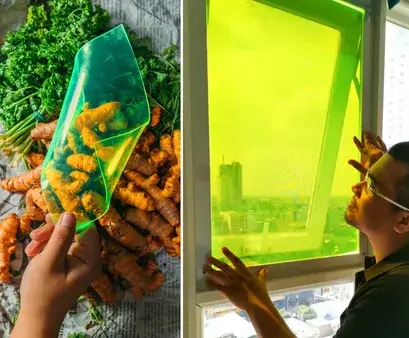
Developed during his engineering studies at Mapúa University in Manila, Maigue’s ground-breaking technology uses natural luminescent compounds derived from upcycled crop waste to turn ordinary building surfaces into ultraviolet-harvesting solar generators.

Inspired by Northern Lights
The inspiration for AuREUS came from the atmospheric physics behind the Northern Lights, or Aurora Borealis. In nature, high-energy particles in the upper atmosphere absorb invisible radiation and re-emit it as luminous visible light. Maigue wondered whether a similar concept could be applied to urban solar energy generation using organic materials.
When severe typhoons devastated agricultural regions across the Philippines, farmers were left with ruined crops and massive economic losses. Maigue recognized an untapped resource in these rotting fruits and vegetables. By testing dozens of local crop varieties, he successfully isolated natural luminescent dyes capable of absorbing high-energy ultraviolet radiation and shifting it into visible light frequencies.

Converting Waste to Electricity
The science behind AuREUS is both simple and sophisticated. The extracted organic luminescent particles are mixed into a durable, molded resin substrate. When sunlight or ambient radiation strikes the panel, the embedded crop-derived particles absorb ultraviolet rays and re-emit them as visible light in all directions.
This re-emitted visible light reflects toward the outer edges of the resin sheet, where conventional photovoltaic solar cells are mounted. These solar cells then convert the concentrated visible light directly into usable electrical power.
Crucially, because ultraviolet rays penetrate cloud cover and bounce off surrounding architectural structures, AuREUS panels do not require direct overhead sunlight to function. They generate clean electricity even under heavy overcast weather or when positioned on vertical building walls that never face the sun directly.

Building Vertical Power Farms
Traditional silicon solar panels are rigid, heavy, and typically installed horizontally on roofs, requiring vast land or surface footprints. AuREUS panels, by contrast, can be molded into various shapes, tinted in vibrant natural colors, sandwiched inside double-glazed glass windows, or attached directly as exterior building cladding.
By covering multi-story modern skyscrapers with AuREUS panels on all sides, entire urban structures can be transformed into vertical solar power farms. Furthermore, by absorbing excess ambient UV radiation in dense city centers, the material helps protect pedestrians and residents from harmful radiation exposure.
Driving the Circular Economy
Beyond energy production, AuREUS provides a practical blueprint for circular economy models. By purchasing damaged crops directly from local farming communities, the project creates a secondary revenue stream for agricultural workers facing climate disruptions. Food scraps that would otherwise end up in landfills are upcycled into high-tech, long-lasting industrial substrates.
In 2020, Maigue’s vision gained international acclaim when AuREUS was named the first-ever global Sustainability Winner of the James Dyson Award. The recognition brought global attention to how developing nations can lead hardware innovations in clean technology.

The Logical Indian’s Perspective
Carvey Ehren Maigue’s AuREUS invention demonstrates that true sustainability is about recognizing new value in what society has discarded. By connecting waste management directly with renewable energy, his work proves that grassroots innovation can solve complex environmental problems through clever, nature-inspired design. Embracing circular innovations will be key to building resilient, self-sustaining cities.
How can urban municipal planning policies encourage the integration of waste-derived materials into green building standards?
Also Read: Mumbai Volunteers Collect 18,000 Kg Waste as Chinu Kwatra Promotes Recycling for School Benches


