




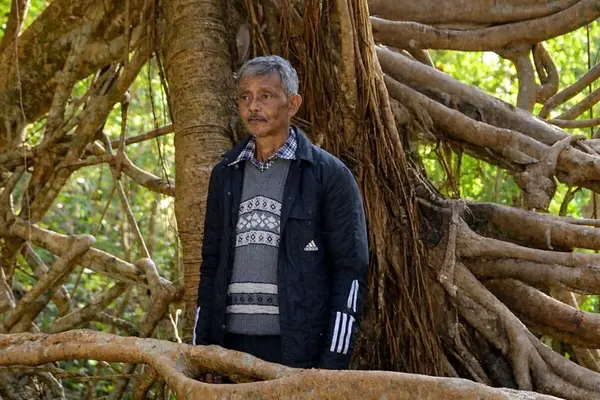
Hally War, a 69-year-old farmer and former village headman from Siej, Meghalaya, was honored with India’s prestigious Padma Shri award on January 26, 2026. This recognition celebrates his five decades of dedication to preserving and strengthening living root bridges—extraordinary natural structures grown from the roots of the rubber fig tree (Ficus elastica) that connect remote communities across the Khasi Hills.
Inspired by his grandfather’s wisdom at the age of 10, War has spent over 50 years guiding aerial roots into bridges that require 15 to 30 years to mature but can last for centuries. His Umkar Living Root Bridge now attracts thousands of visitors annually, contributing significantly to Meghalaya’s burgeoning eco-tourism sector. Chief Minister Conrad K. Sangma praised War’s work as a pinnacle of ancestral wisdom, while Governor C.H. Vijayashankar felicitated him during the 2026 Republic Day celebrations.
A Childhood Shaped by Stories and Rivers
In Siej village, nestled in the East Khasi Hills, a young Hally War listened to his grandfather, Iang Rapthap, weave tales of the Jingkieng Ksier—the mythical golden bridge connecting heaven to earth. These stories served as a cultural compass, teaching children that nature was not a resource to be exploited, but a partner to be nurtured.
When War was nine, his grandfather took him to the banks of the Ummunoi River. There, he witnessed the slow-motion engineering of a bridge grown from living roots. “At around 10 years old, I saw the difficulty people faced while crossing the river,” War recalls. “It became clear that something lasting had to be done. The idea came from my grandparents, who shared stories about the strength of living roots.”
Nature’s Engineering in the Wettest Place on Earth
The southern Khasi hills are home to Cherrapunji and Mawsynram, areas that receive some of the highest rainfall on Earth. During the monsoon, traditional wood or bamboo bridges rot or are swept away by torrential currents. However, the Khasi people perfected a solution: the Jingkieng Jri.
War learned the ancient art of guiding pliable aerial roots through hollowed bamboo poles and wooden frames. By directing these roots across the river toward the opposite bank, he learned to weave them into architectural forms. Unlike concrete, these bridges are self-repairing and grow stronger as the tree matures, eventually becoming thick, cable-like structures capable of supporting dozens of people at once.
The Patient Art of Building for Tomorrow
The most profound lesson War learned was one of patience. A living root bridge is a multi-generational project; the elder who begins the process rarely sees the bridge at its full strength. It is an act of profound faith in the future.
While many of his peers migrated to cities for modern employment, War remained in Siej. He served as the village headman for nearly 40 years, during which time he maintained several bridges. He often warns that while these structures can stand for 500 years, they require constant human care. Neglect, he emphasizes, is the only thing that can destroy this irreplaceable heritage.
From Hidden Wonder to Global Recognition
For decades, War worked in relative obscurity. However, global interest in Meghalaya’s “living architecture” surged after international documentaries featured the bridges. By 2025, tourism in the state reached record highs, with the Umkar bridge in Siej becoming a primary destination for those seeking sustainable travel experiences.
In 2022, the Indian government submitted a proposal to UNESCO for the bridges’ inclusion as World Heritage sites, describing them as the “apogee of the human-plant relationship.” This momentum culminated in early 2025 when Chief Minister Conrad K. Sangma led a cabinet trek to Siej to witness War’s work firsthand, highlighting the bridge as a model for climate-resilient infrastructure.
Recognition at the Highest Level
On January 25, 2026, the Government of India announced Hally War as a recipient of the Padma Shri for his contributions to social work and environmental conservation. For a man who spent his life quietly weaving roots, the national spotlight was unexpected.
“I never imagined that the work I carried out quietly in my village would receive recognition at the national level,” War stated. “This honor belongs to my village and to our forefathers who taught us to live with nature, not against it.”
The Logical Indian’s Perspective
Hally War’s story is a reminder that true progress lies in honoring ancestral wisdom. In a world of “instant” results, War’s 50-year commitment to “slow” infrastructure offers a blueprint for true sustainability. These bridges are not just relics; they are living proof that partnering with nature—rather than dominating it—creates the most resilient solutions.
War’s recognition validates indigenous knowledge as a sophisticated technology that addresses the very environmental challenges modern engineering often overlooks.
Also Read: Madhya Pradesh Officer Feeds, Comforts Abandoned 3-Month-Old Baby During Datia Police Crackdown Operation


