



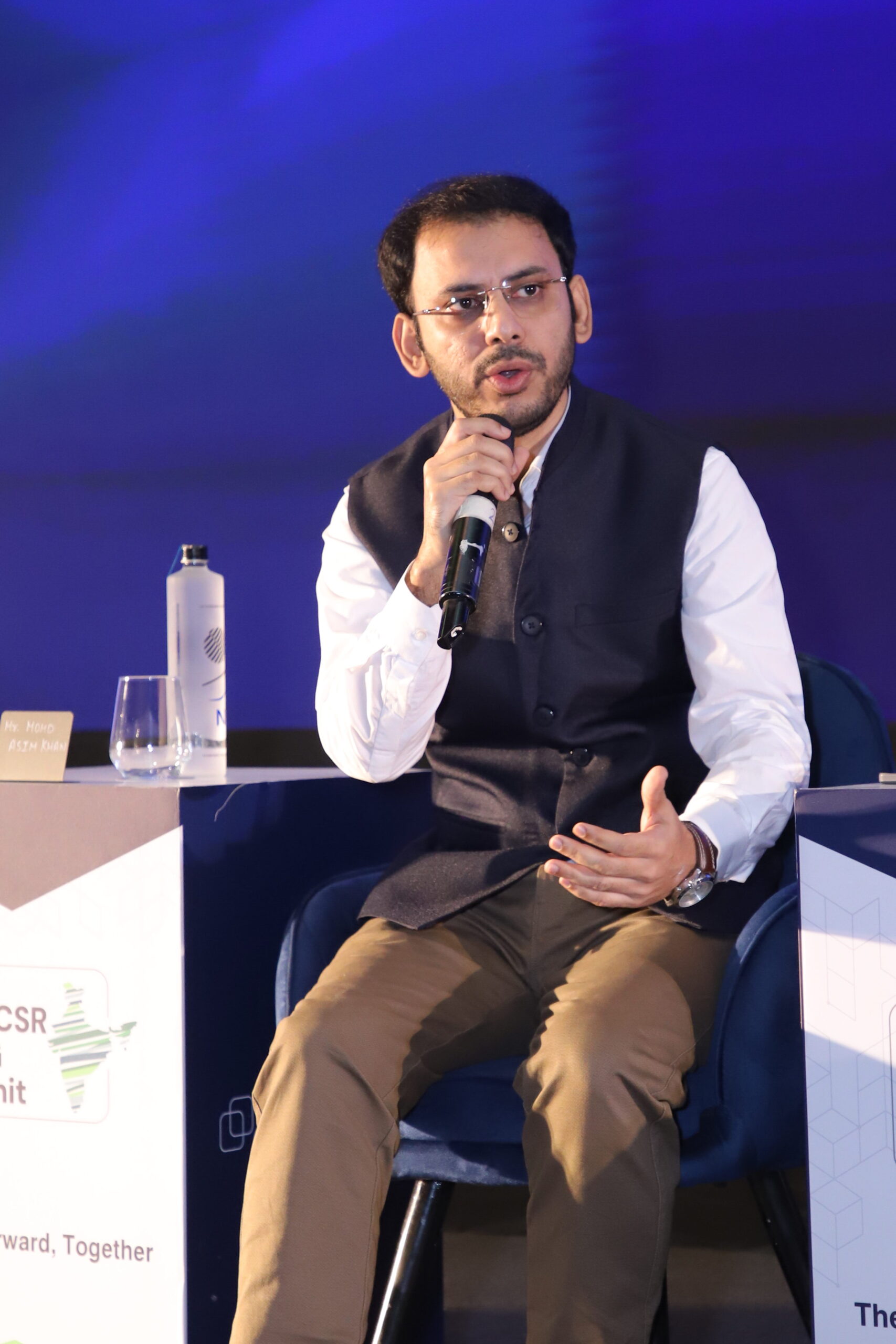
In the thick of Haryana’s stubble-burning season for two years in a row, Mohammad Asim Khan has skipped Diwali at home, opting to live among the farmers he serves. “I haven’t gone home for two years on Diwali leave; I live with these farmers to build a relationship with them and understand why they are burning stubble and what alternatives are available. I have even travelled the length and breadth of rural Punjab to deeply understand the issue from the farmers, as knowing their side of the story seemed imperative,” he shared in conversation with The Logical Indian.
This deep immersion reflects his philosophy: “It is very easy to blame the system, but we need to understand that we have to contribute to the change we want to see.” Far from photo-ops, Asim uses a hands-on approach; deploying machinery, forming farmer groups, and even cultivating rice alongside them.

A Pivot from Journalism Dreams
Asim Khan’s path to social impact began with an unfulfilled aspiration for journalism in 2009. A lot of people told him that journalism was dead in India, yet he persisted until practical hurdles emerged: few quality bachelor’s programs. “I still wanted to do it but couldn’t find many good colleges for a bachelor’s in journalism in 2009, so I consulted my family, who suggested that before doing journalism, I should first understand society,” leading him to a BSW at the prestigious Tata Institute of Social Sciences (TISS) over B.Tech offers with free laptops amid high dropouts.
“I also had B.Tech colleges in hand through the UPTU filter, which would give me a free laptop because B.Tech had the highest dropout that year, around 40,000 seats were left empty.” But by the time B.Tech offers came in, Asim had already finished a semester at TISS and decided to continue it.
His BSW specialization in Rural Development from TISS equipped him to deeply understand India’s rural landscape and broaden his perspective. “Because I chose BSW, I got to know professional social work at the age of 17 through BSW,” Asim says. “Starting early really helps, in my opinion in a way, because you have time to develop your perspective rather than jumping on to them. So, the earlier you can join, the better it is, as you can serve society properly, longer, and deeper; rather than one fine day waking up to quit your existing job to give back to society without knowing much about it.”
“It changed everything because after class 12, you are a blank slate, and I was a blank slate from a science background who ended up doing social work,” Asim says. TISS proved transformative, challenging preconceptions. “When people begin to study social work, everybody comes with perceptions and preconceived notions; it is important to break that,” Asim explains. “I was able to break that notion and work neutrally. Unlearning your own background is very important and difficult.”
He credits great teachers at TISS who helped him break these perceptions; he trusted them fully and it paid off. This foundation equipped him to navigate India’s polarized landscape, where staying unbiased and neutral is very difficult, even saying that a woman can do everything and not judging her for her gender can create a ruckus.
From NGO Fundraising to Corporate CSR Leadership
Asim started his career as a fundraiser and donor manager at an NGO, raising funds from Public Sector Undertakings (PSUs). “I used to raise funds with PSUs, so I got exposure to how PSUs work very early on,” he says, also overseeing implementation for two projects. This bridged to a decade in corporate social responsibility (CSR), where he has worked with various companies, including his current role as National CSR Lead at Cadence Design Systems.
“For a CSR manager, the NGOs are also a team; they are my extended team. I do not differentiate between them,” Asim says to The Logical Indian. Rushed hiring plagues the field: the issue is that when making teams, people are in a hurry to fill vacancies. When not in a hurry, one can talk to them 2-3 times and understand their psyche; once that is done, more than half of the work can be done. “The programs can be well implemented if you scan your partners well. Development happens slowly, so the choice has to be very wise,” Asim explains.
His social work roots inform ground-level strategy. Before finalising the projects, he conducts community visits and builds rapport with them. A background in social work from a prestigious college like TISS helps here, as he worked with communities and government on the ground during that time. “8 out of 10 times, the community and I are able to establish a relationship with each other,” Asim says. Flexibility is key: “When you make a strategy and plan for such a dynamic society, it is important to be flexible and constantly revisit the plan. However, there are some things that should be non-negotiable, like talking and interacting with the communities,” he explains.
Spearheading Stubble-Burning Solutions in Haryana
Asim’s flagship initiative targets stubble burning in Haryana’s Fatehabad district, covering 15 villages identified via 3-4 years of government data analysis. The reason for choosing Haryana is that most corporates working on stubble burning focused on Punjab, leaving Haryana out. Partnering with an NGO (CII Foundation) experienced in solid waste management, the team goes beyond awareness: only awareness doesn’t help, so they set up machinery to take out stubble, bind it, collect and sell it.
A 2,000-farmer group elects representatives to handle buying, selling, and machinery repairs. Big farmers generally have this machinery, but small farmers are struggling. They invited Krishi (Agriculture) University professors with established rapport. Initial resistance gave way: they eventually listened because assets were being created, not just talking and teaching. Asim’s rice cultivation with farmers sealed trust. “The real challenge is earning their trust; the communities can see who is there to actually work and who is there for a photoshoot,” Asim explains. He stresses mutual accountability: “We cannot blame other people for the fire if we do not make efforts to extinguish it. This needs a level of commitment with a strategy and a plan,” Asim says.

CSR’s Phases and Asim’s Advocacy for Change
Asim maps CSR’s evolution in three phases: post-2014, CSR mandate but aesthetic efforts; 2021 law changes mandating unspent fund disclosures, shifting from exhaustion pressure to strategy; and 2023-24’s ESG focus on sustainability, innovation and enterprises. The 2021 CSR Amendment Rules required companies to transfer unspent amounts from ongoing projects to a dedicated “Unspent CSR Account” within 30 days of the financial year-end, with remaining funds after three years moved to Schedule VII funds like PM National Relief Fund. Non-ongoing unspent amounts must go to Schedule VII funds within six months, with penalties up to twice the unspent sum or INR 1 crore for companies. COVID forced CSR to work seriously, with a lot done during that time compared to earlier. This was a major shift. Asim, who earlier used to question why he was in the CSR sector, saw professionalism thriving.
An author of two books, Asim demystifies the sector. CSR: An Act of God covers basics, law, and differences from philanthropy—titled because CSR is an act (an amendment in law language), and it should be acted in a godly way. He views the mandate as a gift of God, vital as foreign funding has dried up and government funding is difficult to obtain. His second book, Social Work During War, examines NGO and social sector roles in warzones amid ongoing conflicts like Ukraine-Russia and Palestine-Israel. It highlights challenges of delivering aid in hostile environments, strategies for neutral operations, and lessons from real-world crises to prepare social workers for humanitarian emergencies beyond peacetime development.

Awards, Academia, and Future Vision
The 2023 Mahatma Award marked a pivotal moment for Asim, coinciding with the release of his first book and reigniting his drive: “When you work and it gets recognised, you get motivated to work more,” he says. This honor, alongside the CSR Times Award and Young Achievers Award, validated his unconventional path in social impact. These recognitions fuelled his commitment to bridging academia and the sector, where he lectures at institutions like IRMA— he recalls an incident when he once inspired some students to pivot from ignorance of CSR to full careers, complete with internships. Asim envisions a seamless flow between classrooms and fieldwork, with NEP 2020-integrated CSR courses in MBAs providing students ground opportunities to challenge notions and gain real-world exposure.
A key advocacy focus is reforming CSR allocation: Asim has written to the ministry during a CSR review meeting, urging that spending in aspirational districts and blocks be made mandatory, with at least 5% of funds allocated there. “I want to see CSR reach the areas and thematic areas at places where it hasn’t already reached in the last 10 years,” he emphasizes, noting that without this, impactful work remains unevenly distributed and truly beneficial change eludes the neediest regions.
He also pushes NGOs to innovate: be more open, shed notions, boost partnerships with CSR, and master skilling, pitching, and reporting. So many NGOs pitch the same thing; they need to stand out and network more at events and summits. To NGOs, he advises: “There are more than 25,000 corporates doing CSR in India, so even if you are not able to work with 200 corporates, there are multiple more options. We are trying, but a little patience is needed,” Asim says to The Logical Indian.
From the Sunderbans to Assam and even Kashmir, Asim has consistently chosen to travel to the margins rather than stay in boardrooms. In Kashmir, people told him that nobody had come to see them so far, a remark that stayed with him as a reminder of how invisible communities can become. By showing up, listening first, and building relationships before demanding change, he pushes CSR to move beyond metro comfort zones and reach those who have long been left out of development conversations. His journey reflects a simple but radical belief: real impact begins where it has been absent the longest.

The Logical Indian’s Perspective
In an era where corporate giving often stops at cheque-signing ceremonies, Mohammad Asim Khan exemplifies purpose with persistence, living among farmers during Diwali, authoring blueprints for ethical CSR, and advocating for funds to flow to forgotten aspirational districts.
His story underscores The Logical Indian’s belief: true social change demands unlearning biases, building rapport over rhetoric, and committing deeply rather than performing superficially.
If you’d like us to feature your story, please write to us at csr@5w1h.media


