




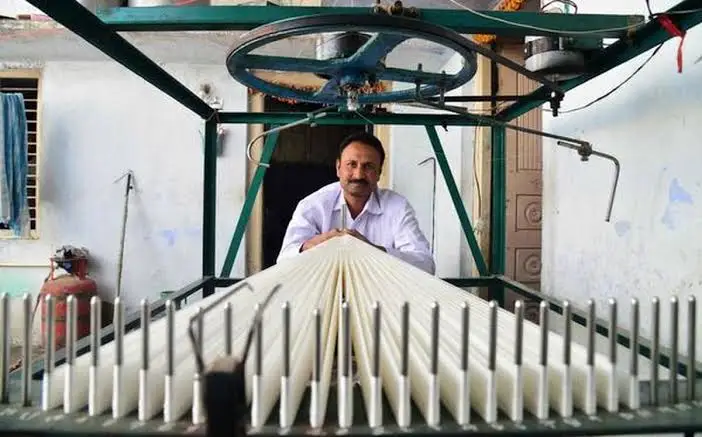
In the traditional weaving villages of Telangana, the world-famous Pochampally tie-and-dye silk sarees are renowned for their intricate geometric patterns. However, behind every beautiful saree lay a painful, hidden reality borne largely by women. Before weaving could even begin, thread had to be wound back and forth across pegs in a tedious, manual process known as Asu. A single saree required a weaver to move her arm up and down over nine thousand times, causing excruciating shoulder joint pain, chronic arthritis, and physical exhaustion over time.
Disturbed by the daily physical agony endured by his mother, Lakshmi, a young school dropout named Chintakindi Mallesham decided to take action. Driven by filial devotion and sheer grit, Mallesham spent seven years developing a mechanized solution, ultimately creating the Lakshmi Asu Machine, an innovation that transformed the lives of thousands of handloom weavers across India.
The Pain Behind the Pattern
Growing up in Sharjipet village in Telangana’s Nalgonda district, Mallesham observed his mother spending up to five hours every day performing the grueling Asu process. Due to poverty, Mallesham had to drop out of school after class ten to assist his family in weaving. As the years passed, his mother’s joint pain became unbearable, to the point where she contemplated quitting weaving altogether.
Seeing his mother in constant physical distress broke Mallesham’s heart. He realized that if a machine could automate the repetitive hand movements of the Asu process, his mother and thousands of women like her could be saved from lifelong physical suffering. Despite having no formal background in electrical or mechanical engineering, Mallesham resolved to build a machine himself.

Seven Years of Failure and Determination
Beginning in 1992, Mallesham set out to build a automated Asu device. With limited financial means, he collected discarded bicycle parts, small electric motors, gears, and scrap metal. He spent every spare rupee he earned from weaving on machine components, often facing severe financial distress and family debt.

For years, his experiments met with repeated failures. Local villagers ridiculed his obsession, calling him crazy for wasting time and money on an impossible dream. At one point, facing immense financial pressure, he temporarily moved to Hyderabad to work as a manual laborer in a machine shop to learn how complex mechanical gear systems operated.
His breakthrough finally came in 1999. By observing how specialized machinery functioned in industrial workshops, he realized how to sequence the thread-winding mechanism. Returning to his village, he assembled a working prototype. When he turned on the machine, it successfully completed the complex thread movement without snapping a single yarn. His mother shed tears of joy as she watched the machine perform the labor that had caused her pain for decades.

Transforming the Handloom Sector and National Acclaim
The Lakshmi Asu Machine was a monumental success. It reduced the time required for the Asu process from over four hours to just ninety minutes per saree. More importantly, it completely eliminated the physical joint strain on women weavers, allowing a single artisan to prepare yarn for multiple sarees a day with minimal physical effort.
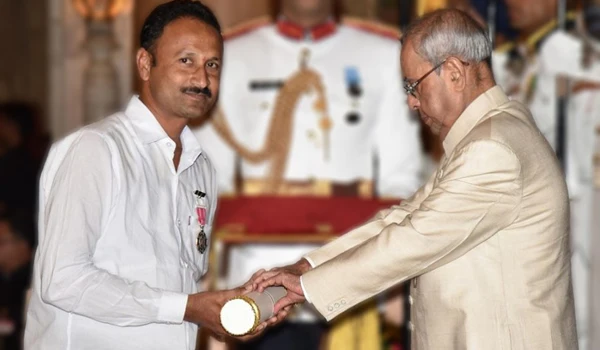
Mallesham’s machine quickly spread across weaving clusters in Telangana, Andhra Pradesh, and Odisha, reviving household handloom economies and empowering female artisans. In 2017, the Government of India honored Chintakindi Mallesham with the prestigious Padma Shri, one of the nation’s highest civilian awards. His inspirational life story was later adapted into the critically acclaimed 2019 Telugu biographical film, Mallesham.
The Logical Indian’s Perspective
Chintakindi Mallesham’s story exemplifies the transformative power of empathy-driven grassroots innovation. through which he created a technology that liberated thousands of women from chronic physical pain while preserving an invaluable cultural heritage craft. His journey challenges the conventional belief that meaningful technological progress requires elite academic institutions or vast corporate funding. When ingenuity is fueled by compassion, a village innovator can solve complex systemic problems, proving that human empathy remains the greatest catalyst for sustainable technology.
How can government agricultural and handloom departments create better incubation funds to identify and scale grassroots inventions like the Lakshmi Asu Machine across rural India?
Also Read: From Gharials to Turtles: The IFS Officer Building a New Conservation Model in UP


