

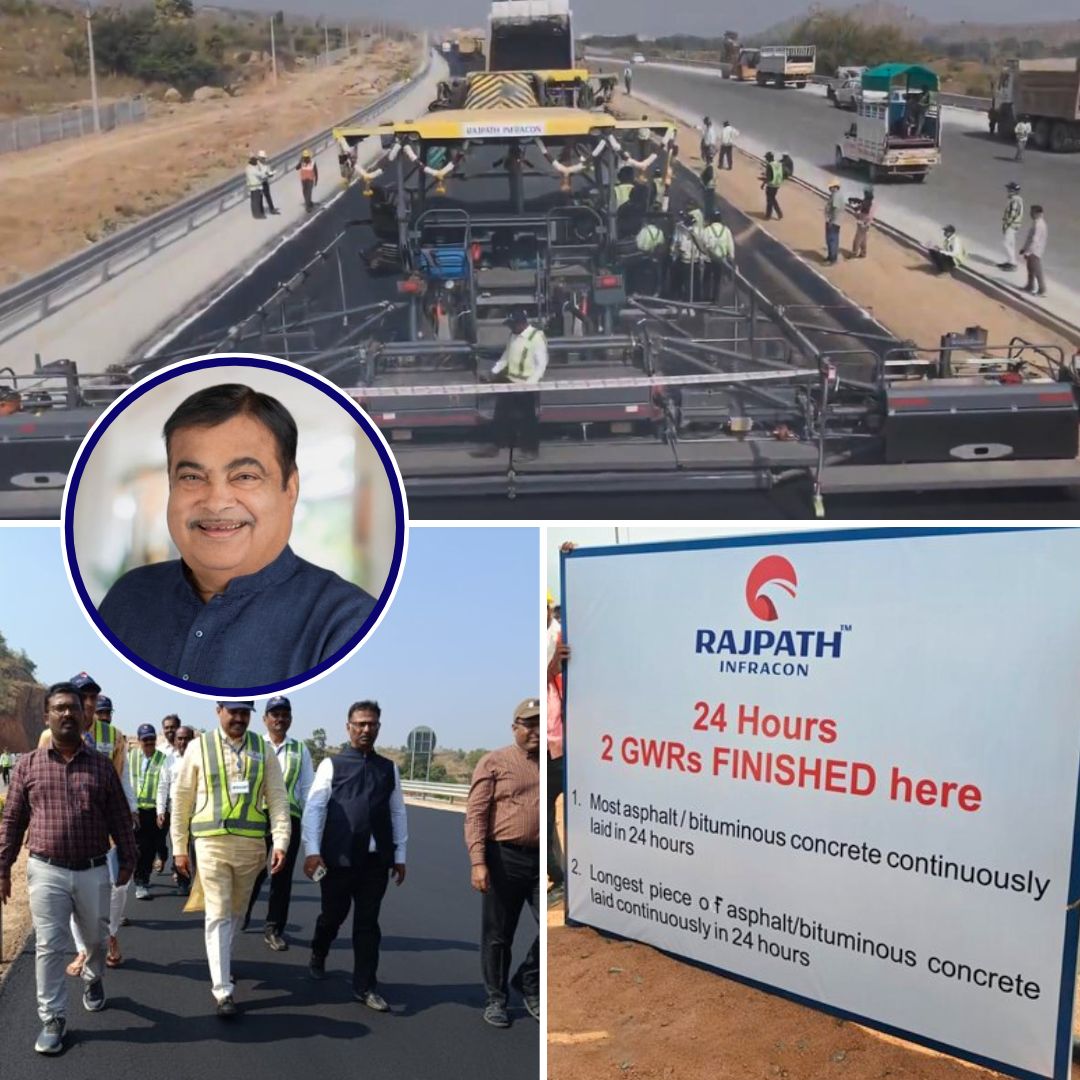

The National Highways Authority of India (NHAI) has etched its name into the Guinness World Records twice after laying 28.95 lane-kilometres of highway and 10,675 metric tonnes of bituminous concrete continuously within 24 hours on the Bengaluru Kadapa Vijayawada Economic Corridor (NH-544G) in Andhra Pradesh.
The achievement was announced by Andhra Pradesh Chief Minister N. Chandrababu Naidu, who described it as “a proud moment for India and Andhra Pradesh,” and credited it to the vision of the Government of India and its sustained thrust on world-class infrastructure.
The road works were carried out by M/s Rajpath Infracon Pvt. Ltd. under stringent quality standards set by NHAI, and reflect India’s growing skills in large-scale infrastructure execution. Officials also said two more Guinness World Records attempts on other portions of the corridor are planned by 11 January 2026.
Record-Breaking Feat on NH-544G
The two records were created on the Vanavolu–Vankarakunta stretch of NH-544G part of the larger Bengaluru–Kadapa–Vijayawada Expressway where a continuous 24-hour operation saw highway builders complete nearly 29 lane-kilometres of surface in a single day.
According to official statements, the works involved layering a high volume of bituminous concrete the material that provides strength and durability to highway surfaces while simultaneously meeting all technical and safety quality checks.
In a social media post shared on X (formerly Twitter), Chief Minister Chandrababu Naidu wrote that the accomplishment “reflects the vision of the Government of India, the sustained thrust on world-class highway infrastructure under Union Minister Nitin Gadkari, and the exceptional commitment of engineers, workers and field teams,” adding that the work was “executed in full compliance with stringent NHAI quality standards.”
He extended his “best wishes” to project teams and highlighted that more record attempts are underway on Packages 2 and 3 of the corridor, with a target completion date of 11 January.
What the Project Entails
The Bengaluru–Kadapa–Vijayawada Expressway (NH-544G) is a flagship infrastructure project taken up under the Bharatmala Phase-II programme, a nationwide road development initiative aimed at improving connectivity and reducing logistics costs.
Spanning both greenfield (new alignment) and brownfield (upgrade of existing road) segments, the corridor estimated to be between 518 and 624 kilometres long traverses the districts of Guntur, Prakasam, Kurnool and Kadapa in Andhra Pradesh before entering Karnataka on its way to Bengaluru.
Once fully completed, this six-lane, access-controlled expressway is expected to reduce travel time between Amaravati (the capital region of Andhra Pradesh) and Bengaluru from about 11–12 hours to nearly six hours.
This will not only ease the movement of passengers but also improve the efficiency of freight and logistics, creating a direct economic link between two major regions.
The decision to route much of the expressway away from congested urban stretches and existing highways is part of a broader effort to facilitate faster, uninterrupted movement of vehicles, thereby enhancing safety and reducing delays. Road developers say this could also support economic growth by improving access to markets, boosting tourism and encouraging regional investment.
Execution, Quality and Workforce
Project execution was led by M/s Rajpath Infracon Pvt. Ltd., working in close coordination with NHAI engineers, machine operators and labour teams.
Officials emphasised that more than speed, the adherence to technical benchmarks including temperature specifications, compaction standards, surface evenness and material consistency was central to achieving the record. These parameters are critical to the long-term durability and safety of the highway.
Quality control teams reportedly conducted rigorous checks during the 24-hour laying operation, ensuring compliance with NHAI guidelines.
While breaking records for distance and material volume laid in a single day, the focus on maintaining dense bituminous macadam levels, layer thickness and material integrity was repeatedly highlighted by officials as a point of pride.
The Chief Minister and authorities also credited the success to the dedication and round-the-clock efforts of troops of engineers, construction workers, supervisors and logistics personnel who coordinated the supply of bituminous concrete and operation of heavy machinery without break for 24 hours. These teams worked in shifts to maintain continuous progress.
Officials’ Statements and Next Steps
Chief Minister Naidu’s comments focused on the symbolic and practical significance of the achievement. He called it “a proud moment for India and Andhra Pradesh” and linked the performance to the broader goal of positioning India as a hub for world-class infrastructure capabilities. He also underscored the leadership of Union Minister Nitin Gadkari in driving high standards for highway development across the country.
The announcement also confirmed that NHAI teams are attempting two additional Guinness World Records on different sections of the economic corridor, scheduled to be completed by 11 January 2026. These upcoming efforts are part of a strategy to sustain momentum and further highlight the corridor’s construction pace.
Road transport and infrastructure analysts see these achievements as part of India’s continued push to improve transport infrastructure, attract investment and integrate economic regions more effectively. However, they also note that long-term performance, maintenance and sustainable design will be important measures of success after the records are set.
The Logical Indian’s Perspective
From a community and development standpoint, such feats of speed, coordination and engineering are undeniably impressive particularly in a sector as foundational as national highways. Rapid construction that meets quality standards can reduce travel times, stimulate commerce and enhance safety.
Yet, we must also ask how such record-setting projects balance speed with sustainability, environmental care and equity. Infrastructure must not only be built fast but built well with attention to land acquisition fairness, ecological impact, road safety, maintenance and long-term utility for the people who use it.
Andhra Pradesh moves ahead,
— Deputy CMO, Andhra Pradesh (@APDeputyCMO) January 7, 2026
with speed, quality, and commitment.
In a remarkable feat, @NHAI_Official and M/s Rajpath Infracon Pvt. Ltd by laying 28.95 lane-kilometres and 10,675 MT of Bituminous Concrete continuously in just 24 hours.
This achievement stands as a strong… pic.twitter.com/N0rc0weKvr