

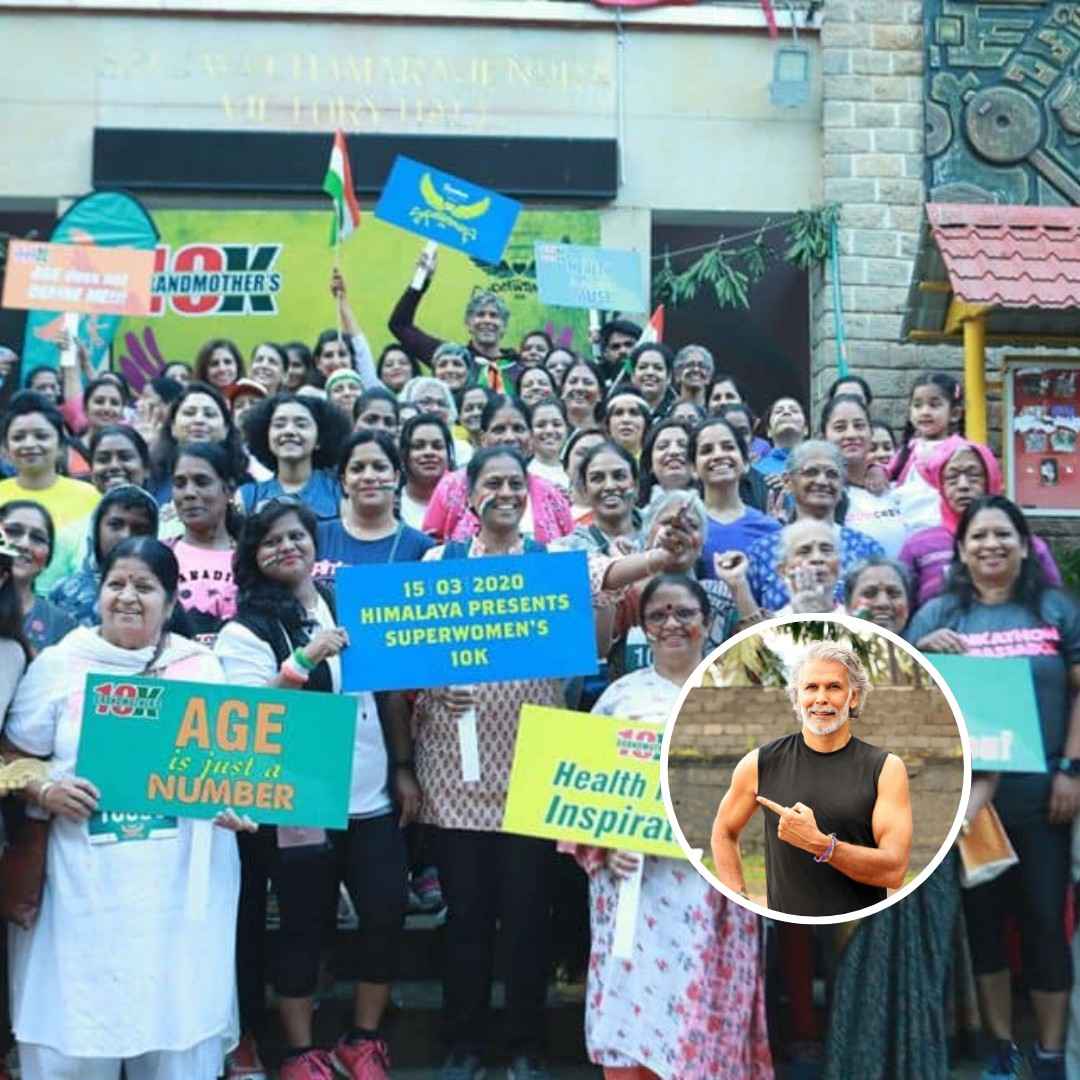

The Grandmother’s 10K was created to challenge how India looks at ageing and fitness. In a country where fitness narratives are still dominated by youth, older women—especially grandmothers—are rarely encouraged to take up physical challenges for themselves. Movement, when it exists, is often framed as necessity, not choice. This initiative offers a radically different way of looking at ageing: one rooted in confidence, independence, and dignity.
Conceptualised as a dedicated running and walking category for women above the age of 55, the Grandmothers’ 10K celebrates senior women who embody resilience and the spirit of active ageing. It is not about speed or competition. It is about visibility. By placing grandmothers at the centre of a large wellness initiative, the run sends a powerful message—that fitness does not belong to a particular age group, and strength does not retire with time.
This belief aligns closely with the philosophy of Pinkathon founder Milind Soman, who has consistently advocated that fitness must be inclusive, accessible, and lifelong. For him, the idea of active ageing is not theoretical—it is something that must be practiced, normalized, and made visible in public spaces.

Why Active Ageing Needs Visibility, Not Sympathy
India’s senior women remain one of the least physically active demographic groups, not because they lack ability, but because society has rarely made space for them to begin. The Grandmother’s 10K addresses this gap by normalizing movement for older women and by repositioning grandmothers as role models rather than dependents.
This shift is deliberate. The initiative challenges long-held assumptions that physical ambition belongs only to the young, and that older women should prioritise rest over resilience. When a grandmother chooses to walk or run, she does more than improve her own health—she reshapes how her family understands ageing.
Daughters and sons see confidence instead of caution. Grandchildren witness strength instead of fragility. This intergenerational influence is central to the design of the Grandmother’s 10K and reflects Milind Soman’s long-standing belief that fitness is most powerful when it inspires by example rather than instruction.
Designed for Dignity, Care, and Confidence
What makes the Grandmother’s 10K especially powerful is the care with which it is designed. The experience prioritises safety and reassurance over performance. Gentle warm-ups led by senior fitness coaches, medical support, hydration, shaded rest areas, and physiotherapy assistance ensure that participants feel supported rather than pressured.
Distances are flexible, allowing women to choose what feels right for them—whether that means taking their first steps through a short walk or completing longer distances they once believed were out of reach. The focus is participation, not proving anything to anyone.
This philosophy closely mirrors what Pinkathon founder Milind Soman has consistently articulated about fitness and inclusion:
“My mother has been a big inspiration, not only to her family but to everyone she meets. At 86, she still treks in the hills. There are women at Pinkathon who started with 3 km and now, in their 60’s and 70’s are running 50 km and even 100 km events.
Fitness is not about age, speed, or competition. It is about consistency, courage, and showing up for yourself—every single day, to enjoy the body and mind that you have been gifted with, lifelong.”
Storytelling is central to the initiative. Through personal reflections and legacy messages written for grandchildren, each grandmother’s journey becomes a story of courage and continuity. At the finish line, every participant is celebrated with a finisher memento—a Tsunamika doll crafted by women affected by the 2004 tsunami—symbolising resilience that endures across time.
Milind Soman’s continued involvement in initiatives like the Grandmother’s 10K reinforces the idea that senior women deserve space, respect, and encouragement—not tokenism.
And this philosophy will not remain on paper.
On 14 December, at dawn, at the Vivekanand Education Society campus in Chembur, senior women—many of them grandmothers—will step onto the track to participate in the Grandmother’s 10K, choosing distances of 10 km, 5 km, and 2.5 km. They will arrive early, supported by families, volunteers, and a community that believes it is never too late to begin. This is not a rehearsal or a symbolic moment. It is the movement in action—taking place where strength, dignity, and age converge.

The Logical Indian Take
At The Logical Indian, we believe inclusion becomes meaningful only when it is visible and lived. The Grandmother’s 10K offers a compelling example of what inclusive fitness looks like when it is rooted in respect rather than rhetoric.
In a society where women are conditioned to place their own health last—and where ageing women are often expected to quietly retreat—this initiative makes a strong and necessary intervention. It affirms that senior women deserve opportunity, not overprotection. That confidence grows through movement, not withdrawal.
Milind Soman’s role in shaping and sustaining the Grandmother’s 10K matters because it demonstrates how leadership can enable change without overshadowing it. By creating space for senior women to step forward—and by standing with them rather than above them—he reinforces a simple but powerful truth: fitness is not about age, image, or perfection. It is about showing up.
When grandmothers run or walk together, they do more than complete a distance. They quietly redefine ageing for families, communities, and generations watching them.
And when that shift unfolds on a running track in Chembur, it becomes clear that this is not just a run.
It is a reimagining of ageing itself.


