




Born into a humble farming family in Nagaland’s Niuland district, Hokato Sema grew up on stories of military valor. Driven by a desire to serve, he joined the 9 Assam Regiment in 2000, aiming for the elite Special Forces. However, fate took a cruel turn in October 2002. During a counter-infiltration operation along the Line of Control (LoC) in Jammu and Kashmir, the 19-year-old soldier stepped on a hidden landmine. The blast resulted in the amputation of his left leg below the knee, bringing an abrupt end to his combat dreams.
An injury of this magnitude would shatter most people, but Sema refused to be defined by his limitations. Supported by the Indian Army’s rehabilitation programs, he adapted to his prosthetic limb and continued his military career, eventually rising to the rank of Subedar.

Redefining Purpose in the Circle of Throw
Sema’s life took another dramatic turn in 2016. At the age of 32, a chance meeting with Lieutenant Colonel Gaurav Dutta at the Army Paralympic Node in Pune introduced him to para-athletics. He picked up the shot put, discovering a new arena to channel his discipline. Under coach Rakesh Rawat and with backing from Olympic Gold Quest, Sema began a grueling training regime.
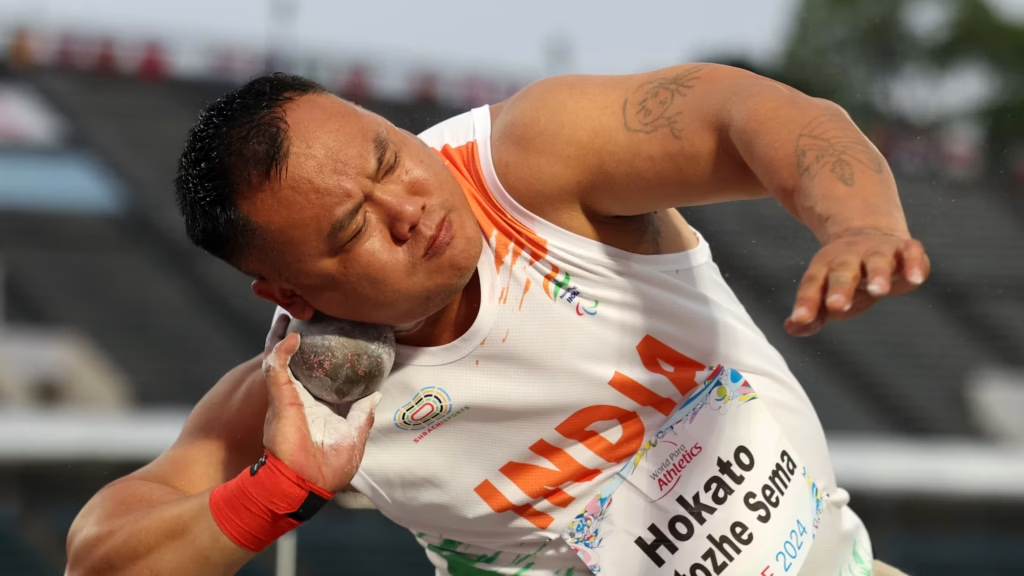
His efforts culminated in glory at the 2024 Paris Paralympics. Competing in the F57 shot put final, Sema recorded a personal-best throw of 14.65 meters to secure a bronze medal, becoming Nagaland’s first-ever Paralympic medalist. Behind this triumph lay profound personal sacrifices, Sema shared that during tough financial phases, his wife, Thanihring Aye, routinely sacrificed her own meals to ensure he received proper athletic nutrition.

A Triumph Built on Silent Sacrifices
The path to the global stage was paved with intense personal hardships and severe financial constraints. While Subedar Sema maintained a grueling training regime under coach Rakesh Rawat and received vital backing from Olympic Gold Quest, the battle for excellence extended far beyond the athletic arena.
During their most difficult financial phases, his family faced a quiet crisis. His wife, Thanihring Aye, routinely sacrificed her own meals to ensure that Sema received the precise, high-quality athletic nutrition necessary to sustain his training. This collective resilience and deep personal sacrifice ultimately fueled his historic breakthrough at the 2024 Paris Paralympics. Competing in the F57 shot put final, Sema recorded a personal-best throw of 14.65 meters to secure the bronze, proudly etching his name as Nagaland’s first-ever Paralympic medalist.
A Historic Honor and Uncharted Horizons
Recognizing his exceptional grit, President Droupadi Murmu conferred the Ati Vishisht Seva Medal (AVSM) upon Subedar Sema at Rashtrapati Bhavan. While the AVSM is a top peacetime military decoration, awarding it to a Paralympian marks a historic milestone in Indian sports history. Having already received the Vishisht Seva Medal (VSM) and the Arjuna Award, Sema is now training intensely to break the 16-meter barrier at the upcoming Asian Games.

The Logical Indian Perspective
Subedar Hokato Hotozhe Sema’s journey is more than just an inspiring sports biography; it reflects a progressive shift in India’s sporting culture. For decades, para-athletes faced structural neglect, and sportspersons from the Northeast struggled with geographic and institutional isolation. Sema’s historic AVSM indicates a welcome change where para-sports are treated with equal dignity and honor compared to mainstream athletics.
His story reminds us that true national pride lies in building institutional support networks rather than just celebrating individual endurance. If a landmine survivor from a remote Nagaland village can conquer the global stage, it proves that talent is universal, but opportunities are not. We must bridge this gap systematically.
How can India systematically scale up its grassroots sports infrastructure in remote and historically overlooked regions like the Northeast to ensure that future sports champions do not have to rely solely on extraordinary personal hardships to be recognized?
Also Read: How Dr Susheelamma Built a Lifelong Welfare Network With Just ₹15 in 1975


