For many people, success is measured by promotions, bigger salaries, and a fast-paced urban lifestyle. But for Sneha Rajguru, her husband Shantanu Paliwal, and her father Anil Rajguru, success meant something entirely different living closer to nature while creating a business that restores the environment instead of exploiting it.

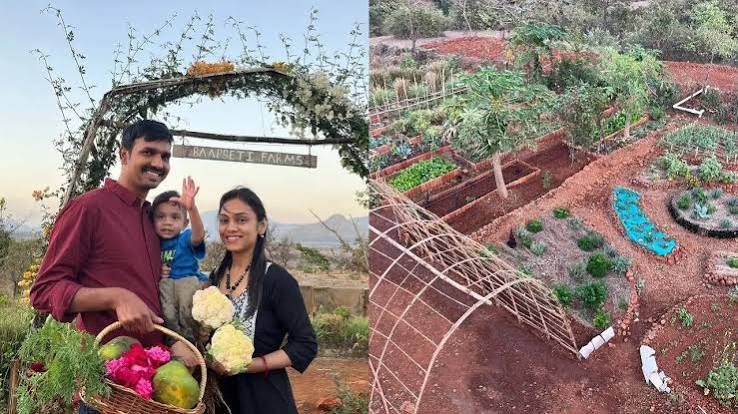
Today, the family runs BaapBeti Permaculture Farm, a two-acre regenerative farm located about 64 kilometres from Pune, Maharashtra. What began as a bold experiment on a rocky, barren plot has evolved into a flourishing food forest with more than 1,350 varieties of plants, welcoming visitors from across India and overseas while generating an annual revenue of ₹15–18 lakh through farm stays, workshops, and consultancy.
Leaving Behind the Glamour of Bollywood
Before embracing farming, Sneha and Shantanu built successful careers in Mumbai’s entertainment industry. Sneha worked as a script supervisor and was part of the production teams behind acclaimed projects including Mimi and Trial by Fire. Shantanu, a Chief Assistant Director, contributed to popular films and web series such as Panchayat, Lipstick Under My Burkha, Jai Gangajal, Gullak, Dream Girl 2, Dabba Cartel, and several other productions. Mimi Trial by Fire Panchayat
Although professionally successful, the couple increasingly questioned the pace and pressures of city life. Constant deadlines, long working hours, and an always-on lifestyle made them rethink what success truly meant.

According to Sneha, life in Mumbai revolved around keeping up with people, work, and lifestyles. What she longed for instead was a slower, more peaceful life where daily living felt meaningful rather than hurried.
A Farm Visit That Changed Everything
The family’s transformation began in 2021 when Sneha visited a permaculture farm in Gorubathan, West Bengal, after completing work on Mimi. Experiencing food grown in harmony with nature inspired her to pursue a completely different path.
Determined to understand regenerative agriculture, she completed a Permaculture Design Course in Hyderabad before purchasing land. Meanwhile, her father Anil Rajguru, who had spent more than three decades working at Tata Motors and was nearing retirement, was also looking for a meaningful second innings. Together, father and daughter decided to build something that would benefit both people and nature.

Turning Barren Land into a Living Ecosystem
In April 2022, the family invested nearly ₹45 lakh of their personal savings to purchase a two-acre plot near Pune. The land was anything but fertile. Years of erosion had stripped away the topsoil, leaving behind exposed rocks and steep slopes. Many believed nothing productive could grow there.
Instead of rushing into cultivation, the family dedicated nearly two years to restoring the ecosystem first. Using contour farming, rainwater harvesting structures, soil regeneration, and the principles of permaculture, they gradually rebuilt the land’s natural fertility. Their goal was not simply to grow crops but to create a self-sustaining ecosystem that functions like a natural forest.
Today, BaapBeti Permaculture Farm is home to over 1,350 varieties of vegetables, fruits, herbs, medicinal plants, grains, and trees, including mangoes, avocados, pineapples, coffee, jackfruit, citrus fruits, berries, Indrayani rice, leafy vegetables, and numerous native species.

Building a Business Around Knowledge, Not Just Produce
Unlike conventional farms that primarily depend on crop sales, BaapBeti Farm follows a regenerative agritourism model. Read More:The family earns revenue through immersive farm stays, educational workshops, guided tours, and permaculture design consultations. Visitors are encouraged to harvest vegetables, understand soil-building techniques, and experience what the founders call “slow living.”
The farm hosts approximately 400–500 visitors annually, including guests from countries such as the UK, Japan, Australia, Canada, and China. Since launching commercial operations in 2023, it has welcomed well over a thousand visitors while generating approximately ₹15–18 lakh in annual revenue, demonstrating that environmentally responsible businesses can also be financially sustainable.
A Vision Beyond Farming
For the Rajguru-Paliwal family, the mission extends beyond agriculture.
Their long-term vision is to create a food forest that eventually requires minimal human intervention, closely mimicking the resilience of natural ecosystems. They also plan to expand through online sales of value-added farm products while continuing to educate aspiring farmers and landowners through workshops and consultancy.
Their journey highlights an important shift in modern entrepreneurship. Innovation does not always emerge from technology or urban startups. Sometimes it grows from restoring degraded land, conserving water, rebuilding soil, and inspiring others to reconnect with nature.
BaapBeti Permaculture Farm is proof that redefining success is possible. By choosing patience over speed, regeneration over extraction, and purpose over prestige, Sneha Rajguru, Shantanu Paliwal, and Anil Rajguru have built more than a profitable enterprise they have created a living example of how business, community, and the environment can thrive together.