




One of the things many of us reach for when we are stressed is the same device that can also contribute to that stress: the smartphone.
It carries our work, news, conversations and entertainment in one place. It is also increasingly difficult to step away from. Marc Balaban, an independent developer and the creator of Pixel Thoughts, has spent years thinking about whether that relationship with technology can be used differently.
How was Pixel Thoughts created
Pixel Thoughts started with a thought about the moon.
Years ago, Balaban came across a Reddit post about someone sitting still and watching the moon slowly set. The experience created a strange shift in perspective: you are one tiny person on one tiny planet, looking at one tiny object in an enormous universe.
Balaban had a similar reaction, “that sense of perspective has always been strangely calming, and helps evaporate my ego.”
He began thinking about anxiety in the opposite way. When a thought becomes overwhelming, the mind tends to zoom in on it until everything else disappears. What if technology could help reverse that?
That became Pixel Thoughts, a 60-second web experience where users type a stressful thought into a star and watch it gradually shrink into the night sky. Balaban built it in 2015, initially as a small experiment. More than 10 million people have used it since.
What surprised me was that, despite having little presence on social media, millions of people have still found their way to the website.

Pixel Thoughts Reached a Harvard Study
Pixel Thoughts eventually found its way into a clinical research setting.
“I was also surprised to discover that it had been referenced in several research papers exploring its use as a mindfulness tool,” Marc recalled.
In a randomised controlled trial conducted at Massachusetts General Hospital, researchers affiliated with Harvard Medical School studied 125 patients who were given either a 60-second Pixel Thoughts exercise or a time-matched educational pamphlet.
Participants were asked to enter a stressful thought into the star and watch it shrink. Immediately afterwards, the Pixel Thoughts group showed statistically significant improvements in several measures, including anxiety, depression and anger. The study only examined the immediate effects of a single session, and the improvement in pain did not reach the researchers’ threshold for clinical significance.
As Marc puts it, “if Pixel Thoughts can give someone just a brief moment of relief, it’s done its job.”
What Tech Could Give Back
Balaban left Uber in 2024 and eventually began working full-time on Pixel Thoughts and related interactive mindfulness experiences.
His thinking now goes beyond the original website. Modern technology, he argues, is often built around capturing attention, keeping people scrolling or encouraging them to buy something. He wants to explore the opposite use of the same technology.
“We live in a world where it’s increasingly difficult to step away from our phones,” he said. “If our phones are going to occupy so much of our lives, they should occasionally give something back to our mental health.”
It is a peculiar idea because the smartphone is both the problem and, potentially, part of the solution.
Making Mindfulness More Personal
The newer version of Pixel Thoughts is designed to make the experience more personal. Instead of giving everyone the same meditation, the app can respond to what someone is going through and offer different ways of looking at it, depending on what resonates with them.
AI is one of the tools that helps make this possible, but Balaban does not see Pixel Thoughts as an “AI solution”. “It’s a mindfulness experience that happens to use some AI where it’s useful,” he said.
There is also some early feedback from users. Balaban has collected more than 3,000 ratings of the personalised meditations and says they have consistently been rated higher than the original, non-personalised experience.
He still considers traditional meditation the strongest form of mindfulness. “But the reality is that, throughout the day, most of us instinctively reach for our phones whenever we have a spare minute, feel stressed, or just need a break. Rather than pretending that habit doesn’t exist, I’d love to gently redirect it,” said Balaban.
Does Marc Use It Himself?
I asked Marc whether he actually uses Pixel Thoughts himself. He said he does, quite often.
“Especially when building Pixel Thoughts and I’m feeling a little overwhelmed…but it always has little nuggets of advice for me,” and he shared a snippet of his interaction with Pixel Thoughts.
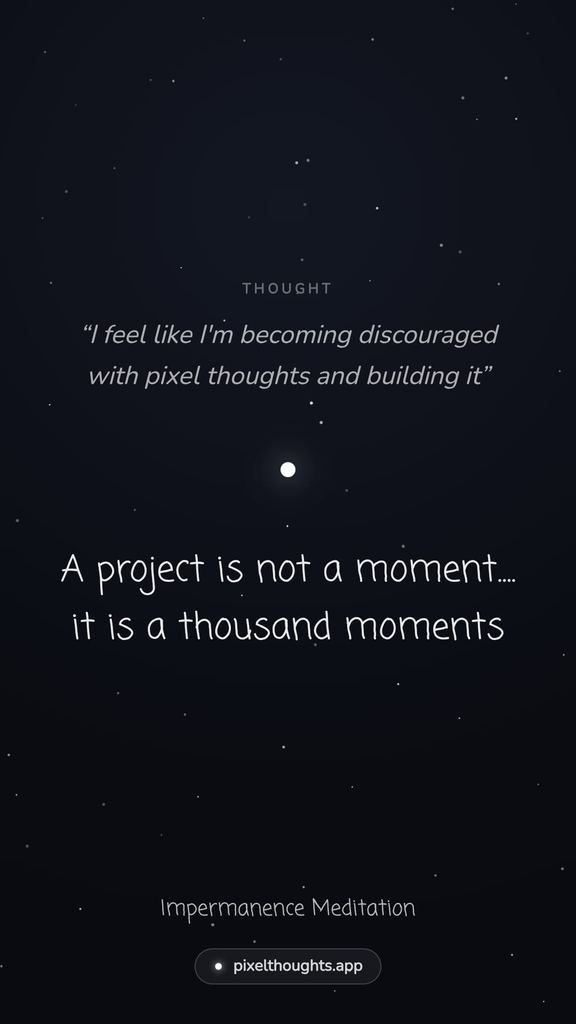
“Another time was a large gathering with a lot of friends. We’d had several big, social days in a row, and I reached a point where I just felt overwhelmed. I didn’t really want to interact with anyone, was feeling just bogged down and wanted to hide a little. I wanted to play chess, but had recently deleted it from my phone. So popped up Pixel thoughts instead to deal with my overwhelm head-on.”
“The meditation reminded me that it was okay to feel overwhelmed, that I didn’t need to fight the feeling or try to be a different person in that moment, and it was okay just to exist like this. It gave me a sense of acceptance rather than resistance… and a moment of slowness,” he said.
Sometimes, Marc says, people do not need to solve everything in front of them. They need a moment in which the problem feels a little smaller.
“I want people (including myself) to pause for a moment. To accept themselves, to remember that they don’t have to solve everything, and just to simply exist without carrying the weight of everything on their shoulders,” said Balaban.
Read More: How Kerala’s Carbon & Whale Founders Are Turning Plastic Waste Into Furniture


