




For over two decades, Shishir Joshi has worked closely with people, institutions and public issues. Today, he brings that experience to Project Mumbai, the award-winning non-profit he founded to bridge the gap between citizens, corporates, and the government to spark civic action. The organisation operates at the intersection of Samaaj-Sarkaar-Bazaar.
Mumbai is often stereotyped as a cutthroat, fast-paced metropolis where people are too busy surviving to know their own neighbours. Joshi, however, recognised a different reality, a profound generosity hidden beneath the relentless rush. By creating avenues for people to contribute their time, skills and resources, Project Mumbai set out to make giving back easier and to turn individual acts of kindness into collective civic action.
In this exclusive conversation, Shishir Joshi shares how Project Mumbai, which approaches its eighth anniversary in September has evolved into the city’s leading problem-solving organisation, impacting over two crore lives, or nearly 10,000 people every day. It’s a one-of-a-kind institution in India.

The Philosophy Of Project Mumbai
Mumbai can appear, at first glance, to be a city defined by urgency – crowded trains, long commutes, demanding workdays and little time to spare. But Joshi saw another side of the city: people who are willing to help, contribute and give their time when they see a meaningful opportunity to do so. The COVID-19 pandemic brought that instinct into sharp focus.
As the city went into lockdown, people were suddenly confronting needs that were immediate and deeply personal, from food and medicines to technology and basic support for those isolated at home. At the same time, there were citizens looking for ways to help, even when they could not leave their homes. Project Mumbai became a bridge between the two.

Some of Project Mumbai’s volunteers ran free kitchens. Others used their technology skills to help elderly people make video calls. When a cancer patient in the distant suburb of Kandivali desperately needed chemotherapy medicine from Dadar during a strict lockdown, Project Mumbai coordinated a four-person volunteer relay. One volunteer carried the medicine from Dadar to Bandra, handed it to another who took it to Andheri, and a final volunteer delivered it safely to Kandivali.
Furthermore, Joshi recognised the plight of female police officers working under the gruelling sun during the lockdown. He sourced unused, clean vanity vans from the film industry, partnered with Procter & Gamble for biscuits and sanitary pads, and converted the vans into safe mobile bathrooms for women in uniform across the city.

For Joshi, the experience reinforced an idea that had been central to Project Mumbai from the beginning: “the problem is not necessarily a lack of kindness. It is finding simple, practical ways to channel it. That thinking would go on to shape the Pin Code Project, Project Mumbai’s volunteer network and its larger Public-Private-People model.”
The Pin Code Project
Joshi realized early on that among the biggest barriers to volunteering were Mumbai’s geographical friction and mismatched interests. If a volunteer is asked to commute two hours after work to help, they will quickly burn out. To solve this, Project Mumbai launched the “Pin Code Project”, allowing citizens to volunteer strictly within their immediate geographic area.
Furthermore, the project matches tasks to personal passions. Instead of forcing a writer to do waste management, they are offered choices ranging from art and teaching to stamp collection.
This localised approach successfully activated a Public-Private-People (PPP) partnership model. Because Mumbai’s municipal governance is massive and multi-layered, there is often a trust deficit. Project Mumbai acts as the trusted enabler, connecting willing citizens and corporate donors directly with local municipal officers to execute hyper-local solutions.
Making Kindness Visible
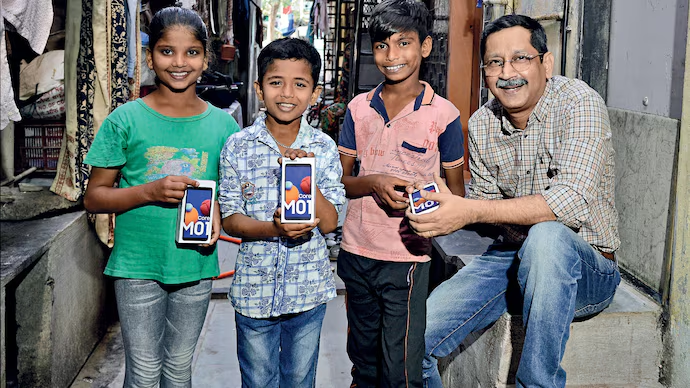
Project Mumbai’s initiatives are purposefully designed to be simple, scalable, and striking. Its ‘Daan Utsav’ initiative taps into the deep-rooted Indian cultural ethos of giving (daan) by asking citizens to donate their plastic waste. Project Mumbai recycled the plastic into public benches for children, giving donors a tangible, visual return on their contribution and keeping the waste out of landfills.

This creative recycling model also gave rise to a free public library at the massive Churchgate Station in South Mumbai. The physical structure of the library was built entirely from recycled plastic waste. The books came from the kindness of citizens, including actress Dia Mirza. Local students built an app for it, and citizen volunteers dedicate a few hours a week to manage it. The library was inaugurated by South African cricketer AB de Villiers. To promote sustainability, de Villiers traveled to the inauguration via the Mumbai Metro.
Over the years, during his IPL visits, de Villiers has heavily supported Project Mumbai by participating in beach clean-ups, painting school walls, playing wheelchair cricket, and joining talks on climate and sports.

Democratizing The Climate Conversation
Project Mumbai has also brought the global climate conversation to India and Mumbai, while making it citizen-led and experiential. In February, it hosted the inaugural edition of Mumbai Climate Week, an idea inspired by London Climate Week and Climate Week New York, which focus largely on the Global North.
Joshi saw an opportunity to create something with a distinct purpose: a platform from the Global South that could bring its own voices, challenges and solutions into the global climate conversation. MCW’s inaugural edition itself featured more than 500 speakers and participants from 30 countries.
To make the subject accessible, they linked climate action to everyday citizen interests like food, cinema, art, and sports. The event featured global and Indian icons, including Hillary Clinton, cricketers Sachin Tendulkar and Ajinkya Rahane, and Indian cosmonauts Rakesh Sharma and Shubhanshu Shukla. Prince William’s Earthshot Prize also made its India debut at the Mumbai Climate Week. (For the first time ever, the Earthshot Prize will be held in India in November 2026. Joshi is on their prestigious India Advisory Council).

Scaling Beyond Mumbai
Joshi hopes to see the Project Mumbai framework adopted in other cities like Chennai or Indore, and offers pro-bono strategic help to set them up. But he insists that true civic movements must be run organically by local citizens, not exported from afar.
For professionals seeking to create an impact in the social sector, Joshi stresses that there is no need to save the world all at once. Instead, he offers a highly actionable roadmap for everyday citizens:
“Start with something small. Be the custodian of the 100 meters where you live and work. Kindness can be deployed even by acting on these two questions: Can I thoughtfully compliment or acknowledge two people every day? Can I make a no-agenda call to someone I have not spoken to lately and make their day? Through small actions, you can make a world of change without trying too hard to change the world.”

The Logical Indian’s Perspective
Project Mumbai proves that civic transformation doesn’t require millions of people; it just requires a few citizens willing to give a fraction of their time to their immediate surroundings. It doesn’t just need people with ideas, but a leader who can inspire and implement them. By removing the friction from volunteering, matching tasks to people’s actual skill sets, and treating citizens as partners rather than just donors, Joshi has turned basic human decency into a highly effective, scalable infrastructure.
If every citizen simply took responsibility for the 100 metres around their home, how quickly could we transform our sprawling, overwhelmed megacities into thriving, connected communities?
If you’d like us to feature your story, please write to us at csr@5w1h.media


