




What if the best way to fight a water crisis is to prepare long before it begins? This question is driving a massive administrative shift in Maharashtra’s easternmost district, Gadchiroli. With the El Niño phenomenon threatening to disrupt rainfall patterns and trigger severe water stress across India, traditional governance would dictate waiting for the monsoon to fail before deploying emergency relief funds.
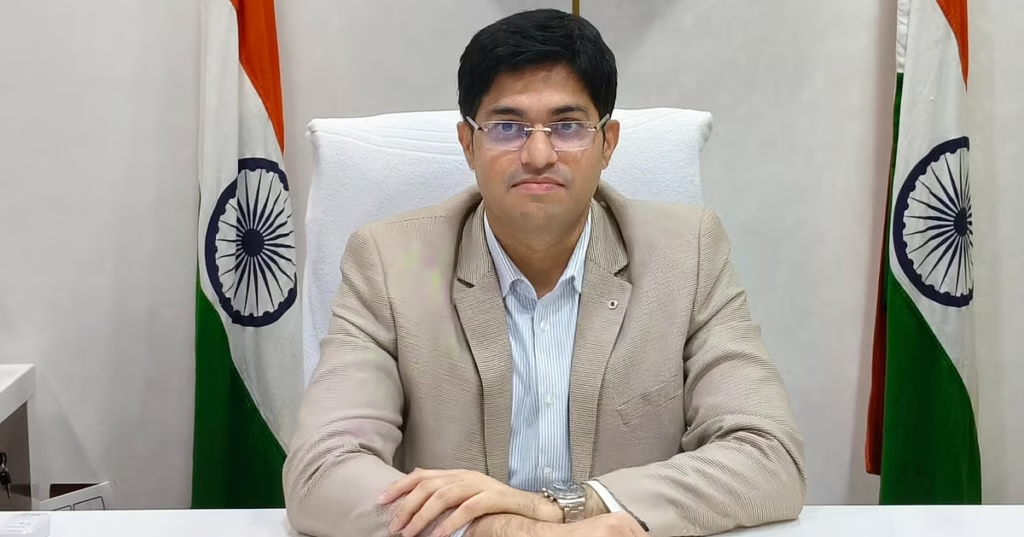
However, District Collector Avishyant Panda is rewriting that script. Recognizing that an uneven monsoon could severely devastate a district heavily reliant on agriculture, the administration launched an aggressive, pre-emptive strategy. The philosophy is refreshingly simple: don’t wait for drought – prevent it entirely by fortifying local water lifelines.
Building Infrastructure and Storage at an Unprecedented Scale
Under Panda’s leadership, the district has pushed for the rapid completion of over 4,600 distinct water conservation works. These include check dams, decentralized farm ponds, and groundwater recharge units specifically designed to capture and hold every drop of rainwater. Alongside these conservation efforts, more than 1,000 irrigation projects are being finalized to directly insulate local farmers from monsoon unpredictability.
Crucially, the drive focused heavily on restoring existing water bodies. Workers successfully excavated nearly 7.5 lakh cubic meters of accumulated silt from local ponds, streams, and reservoirs. This massive desilting effort has radically expanded the district’s natural storage capacity, creating billions of cubic feet of additional water retention to safeguard rural communities through extended dry spells.

A Grassroots Model Rooted in Community Resilience
What makes the “Gadchiroli Model” remarkably effective is its deep integration with the district’s demographic fabric. Gadchiroli is heavily forested with a large tribal population that has historically faced geographic isolation. Rather than imposing top-down bureaucratic mandates, the administration heavily leveraged Gram Sabhas, turning the conservation drive into a shared public mission.
Involving local bodies directly in the planning and execution ensures that check dams and farm ponds are built exactly where the community needs them most. This people-centric approach bridges the gap between governance and rural citizens, fostering long-term community ownership of these shared natural resources.

The Presidential Stamp of Excellence
This preventive strategy and deep community alignment have not gone unnoticed on the national stage. In late 2025, District Collector Avishyant Panda was called to Rashtrapati Bhavan, where President Droupadi Murmu honored him for his outstanding performance in public administration under the Adi Karmayogi Abhiyan. This prestigious recognition highlighted Gadchiroli as a benchmark for public welfare, making it the only district selected from the entire state of Maharashtra for this administrative excellence award.
The presidential honor specifically celebrated the “Gadchiroli Model” for successfully integrating 17 different government departments to serve vulnerable tribal populations. By turning policy into active, accessible grassroots solutions, the award validated Panda’s core philosophy: that effective governance is defined by listening to the community and building systems that protect citizens before a crisis ever hits the ground.

The Logical Indian Perspective
The proactive measures underway in Gadchiroli present a vital lesson for India’s broader climate adaptation strategy. For decades, the administrative response to water scarcity has been deeply reactionary like trucking in water tankers, declaring disaster zones, and distributing financial compensation only after crops have failed and reservoirs have run dry.
IAS Avishyant Panda’s approach challenges this unsustainable cycle. By investing heavily in preventive infrastructure, Gadchiroli proves that administrative foresight can significantly mitigate the harsh impacts of climate uncertainty. True governance does not lie in managing a full-blown crisis efficiently; it lies in building the structural resilience necessary to stop the crisis from manifesting in the first place.
As climate change makes global weather patterns increasingly volatile, shouldn’t decentralized, preventive water models like Gadchiroli’s become mandatory policy for every drought-prone district across India?


